TWO:[See larger version]THE "MEDIATOR" BREAKING THE BOOM AT LA ROCHELLE. (See p. 585.)
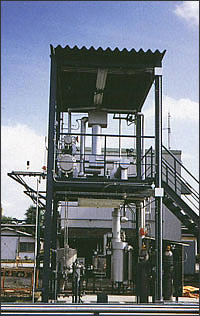
Great attention is recently being paid to global environmental issues, and it is now conceivable that companies will need to treat used solvents themselves. In consideration of this kind of social issue, we have developed a “membrane separation type solvent dehydration system,” which uses a polyimide membrane with superior dehydration properties developed by Ube Industries, Ltd. in combination with our own distillation and concentration technology that has resulted in solvents being more easily recovered.
THREE:But the violent proceedings of Hastings and his Council, partly against each other, and still more against the natives, did not escape the authorities at home. Two committees were appointed in the House of Commons in 1781, to inquire into these matters. One of them was headed by General Richard Smith, and the other by Dundas, the Lord Advocate of Scotland. In both of these the conduct of Hastings, especially in the war against the Rohillas, was severely condemned, and the appointment of Impey to the new judicial office was greatly disapproved. In May, 1782, General Smith moved an address praying his Majesty to recall Sir Elijah Impey, which was carried unanimously, and he was recalled accordingly. Dundas also moved and carried a resolution declaring it to be the duty of the Court of Directors to recall Warren Hastings, on the charge of his "having, in sundry instances, acted in a manner repugnant to the honour and policy of the nation." The Court of Directors complied with this suggestion; but Lord Rockingham dying, his Ministry being dissolved, and Burke, the great opponent of Indian oppressions, being out of office, in October the Court of Directors, through the active exertions of the friends of Hastings, rescinded his recall. The succeeding changes of administration, and their weakness, first that of the Shelburne, and then that of the Coalition Ministry, enabled Hastings to keep his post in India, and finish the war in Madras. It was the India Bill of Pitt in 1784, which, by creating the Board of Control, and enabling the Government to take immediate cognisance of the proceedings of the Governors-General, and other chief officers in India, broke the power of Hastings, and led him to resign, without, however, enabling him to escape the just scrutiny which his administration needed.
- 1Under the distillation system, even in case of azeotropic solvent compositions, this system which remove water vapor by the polyimide membrane will easily dehydrate.
- 2In comparison with the distillation system, it significantly saves on use of steam.
- 3Dehydration can be performed through merely supplying evaporated vapor to the membrane module and maintaining the differential pressure between the permeable side and the impermeable side.
- 4Solvent purity of 99.9% or more can be achieved by carrying out dehydration with a polyimide membrane only.
- 5The polyimide membrane has superior heat and solvent resistance. Therefore, the vapor permeation system reduces contamination of the membrane and thus extends its life.
THREE:On hearing this, Burgoyne dispatched Colonel Baum with two pieces of artillery and eight hundred men¡ªdismounted German dragoons and British marksmen. They were to surprise Bennington, a place about twenty miles to the east of the Hudson, where the Americans had collected their stores from New England, and, having secured these, to return and carry them to St. Leger. Baum, however, found himself surrounded by Generals Starke and Warner at St. Corick's Mill, on Walloon Creek, six miles from Bennington, before help came up. For two hours a fierce attack was kept up on Baum's entrenchments on all sides by the Americans with muskets and rifles. Baum made a most gallant defence, and three times drove them from some high ground which they occupied above his camp. At last he was picked off by a rifleman and fell mortally wounded. His German troops retreated into the woods, in the direction of Fort Edward, and were there met by Breyman, who was slowly advancing with reinforcements. He reorganised the fugitives, and commenced his retreat, hotly pursued by Starke and Warner; he made his way back to Burgoyne, but not until he had fired nearly his last cartridge.James Bradley (b. 1692), who succeeded Halley as the third Astronomer Royal, held that post till 1762, when he died. He had in 1728 distinguished himself by his discovery of an unanswerable proof of the motion of the earth by his observations on the apparent alteration in the place of a fixed star. His second great discovery was that of the mutation of the earth's axis, showing that the pole of the equator moves round the pole of the elliptic, not in a straight but in a waving line. Bradley gave important assistance to the Ministry in their alteration of the calendar in 1751, and the vast mass of his[153] observations was published after his death, by the University of Oxford, in two volumes, in 1798.
The aromatic polyimide membrane is highly permeable to water vapor but less permeable to vapors of organic compounds such as alcohol etc.
THREE: Progress of the War on the Continent¡ªLethargic Condition of Politics¡ªBattle of Laufeldt¡ªCapture of Bergen-op-Zoom¡ªDisasters of the French on the Sea and in Italy¡ªNegotiations for Peace¡ªCongress of Aix-la-Chapelle¡ªConditions of Peace¡ªPeace at Home¡ªCommercial Treaty with Spain¡ªDeath of the Prince of Wales¡ªPopular feeling against the Bill for Naturalising the Jews¡ªLord Hardwicke's Marriage Act¡ªFoundation of the British Museum¡ªDeath of Pelham¡ªNewcastle's Difficulties¡ªFailure of Robinson¡ªApproaching Danger from America¡ªA State of Undeclared War¡ªThe Battles of Boscawen and Braddock¡ªGeorge's Anxiety for Hanover¡ªSubsidiary Treaties against Prussia¡ªPitt's Opposition¡ªDebate in the House of Commons¡ªDanger of England¡ªFrench Expedition against Minorca¡ªThe Failure of Byng¡ªNewcastle resigns¡ªAttempts to Form a Ministry¡ªDevonshire Succeeds¡ªWeakness of the Ministry¡ªCoalition against Prussia¡ªAlliance with England¡ªCommencement of the Seven Years' War¡ªFrederick Conquers Saxony¡ªGloominess of Affairs¡ªCourt-Martial on Byng, and his Death¡ªDismissal of Pitt¡ªThe Pitt and Newcastle Coalition¡ªFailure of the attack on Rochefort and of that on Louisburg¡ªConvention of Closter-Seven¡ªFrederick's Campaign; Kolin, Rosbach, and Lissa¡ªSuccesses elsewhere¡ªWolfe and Clive¡ªBattle of Plassey¡ªCapture of Louisburg¡ªTiconderoga and Fort Duquesne¡ªAttacks on St. Malo and Cherbourg¡ªVictory of Crefeld¡ªFrederick's Campaign¡ªCommencement of 1759; Blockade of the French Coast¡ªPitt's Plans for the Conquest of Canada¡ªAmherst's and Prideaux's Columns¡ªWolfe before Quebec¡ªPosition of the City¡ªWolfe fails to draw Montcalm from his Position¡ªApparent Hopelessness of the Expedition¡ªWolfe Scales the Heights of Abraham¡ªThe Battle¡ªSuccesses in India¡ªBattle of Quiberon¡ªFrederick's Fortunes¡ªCampaign of Ferdinand of Brunswick¡ªBattle of Minden¡ªGlorious Termination of the Year¡ªFrench Descent on Carrickfergus¡ªAttempt of the French to Recover Quebec¡ªTheir Expulsion from North America¡ªFrederick's Fourth Campaign¡ªSuccesses of Ferdinand of Brunswick¡ªDeath of George II.Mr. Vandeleur, made judge of Queen's Bench 3,300
- 1 Recovery of the detergent solvent Recovery of the cleaning solvent such as electronic parts industry, precision instrument industry.
- 2Solvent recovery and the refinement Solvent recovery and the refinement such as chemical industry, an industry of medical supplies, food industry, the fermentation industry.
THREE:This was to send a part of Lincoln's militia, under Colonel Brown, to endeavour to surprise Fort Ticonderoga, Mount Independence, and Fort George, to capture or destroy all the stores there, to hold them in strong force, and thus completely to cut off Burgoyne's retreat by the lakes to Canada. Brown, being joined by another body of militia under Colonel Johnson, invested Ticonderoga. Being repulsed there, he sailed through Lake George in the vessels he had taken; made a fresh attempt upon Diamond Island, and, being also repulsed there, he set fire to the captured vessels, and returned to the American camp in the rear of Burgoyne. Partial as his success had been, he had, however, opened the route, and whilst he and the rest of the militia were watching Burgoyne, other bodies of Americans were mustering in his track, and the retreat of Burgoyne became an impossibility. He could stay where he was no longer. His provisions were exhausted; his horses were dying for lack of forage, and his situation was most deplorable.
Acetone, ethanol, methyl ethyl ketone, butanol, isopropyl alcohol, ethyl acetate, methyl isobutyl ketone, others (including hexane and toluene).
